Photoderm SPOT-AGE SPF 50+
BIODERMA
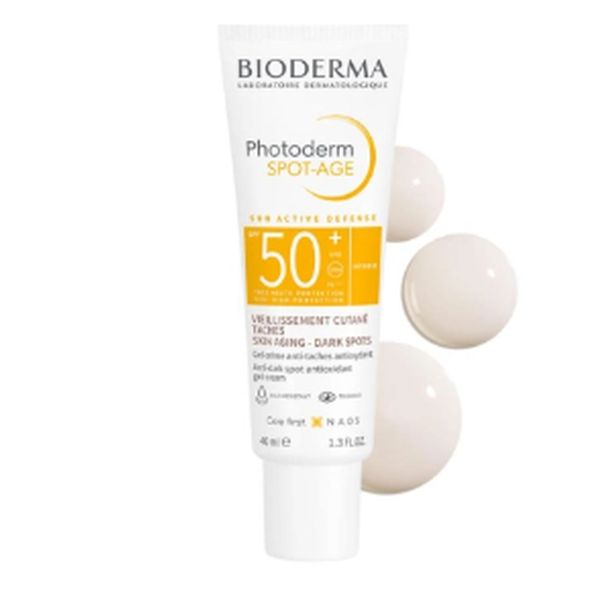
Photoderm SPOT-AGE SPF 50+
BIODERMA
PHOTODERM SPOT-AGE SPF50+
Suncare Face, Neck
Antioxidant boosted suncare, reduces spots and wrinkles.
BIODERMA
BIODERMA
PHOTODERM SPOT-AGE SPF50+
Suncare Face, Neck
Each of our ingredients have been selected for their effectiveness. Find all the ingredients of your product grouped into families according to their role.
The ingredients of our formulas have been selected according to very strict dermatological criteria and recommended by independent toxicological experts. Classified in three main categories of active ingredients, you will discover the nature, role and origin of each by clicking on their name.
Here are grouped the ingredients that contribute to the expected effectiveness of the product: those that optimize or preserve the biological skin's mechanisms (such as hydration, regeneration, lipid-replenishing action), and those that have a very specific physico-chemical action (exfoliating, matifying, sun filters ...).
The ingredients listed here are those contained in the latest formula for this product. As there may be a time lag between its production and its distribution on the market, we invite you to consult the list of ingredients on the packaging.
Sodium citrate
What is it?
Citric acid derivative.
What’s the point?
Stabilising: contributes to the product’s homogeneity or stability.
How do you get it?
Component naturally found in the skin, obtained by biotechnology.Biotechnology uses biological processes, including natural fermentation, to obtain ingredients.
1,2-hexanediol1
What is it?
Polyol.
What’s the point?
Stabilising: contributes to the product’s homogeneity or stability.
How do you get it?
Synthesis
To select an ingredient, NAOS can call on synthesis in order to:
- reconstitute a natural molecule without having to extract it from a plant and thus better respect biodiversity,
- obtain a pure, perfectly defined ingredient.
Caprylyl glycol
What is it?
Polyol.
What’s the point?
Stabilising: contributes to the product’s homogeneity or stability.
How do you get it?
Synthesis
To select an ingredient, NAOS can call on synthesis in order to:
- reconstitute a natural molecule without having to extract it from a plant and thus better respect biodiversity,
- obtain a pure, perfectly defined ingredient.

Glycine soja (soybean) oil
What is it?
Soybean oil.
What’s the point?
Nourishing: strengthens the skin’s protective film and the epidermis’s structure by supplying lipids.
How do you get it?
Soybean extraction.
Citric acid
What is it?
Citric acid.
What’s the point?
Stabilising: helps adjust the product’s pH.
How do you get it?
Component naturally found in the skin, obtained by biotechnology.Biotechnology uses biological processes, including natural fermentation, to obtain ingredients.
Ectoin
What is it?
Amino acid.
What’s the point?
Contributes to Cellular Bioprotection technology.
This complex reinforces the skin cells' natural defence system to increase their resistance to the negative effects of the sun's rays.
How do you get it?
Biotechnology.
Biotechnology uses biological processes, including natural fermentation, to obtain ingredients.
Mannitol
What is it?
Sugar derivative.
What’s the point?
D.A.F. technology (Dermatological Advanced Formulation)
This technology increases the skin's tolerance threshold - whatever its type - to boost its resistance.
Contributes to Cellular Bioprotection technology.
This complex reinforces the skin cells' natural defence system to increase their resistance to the negative effects of the sun's rays.
How do you get it?
Obtained from sugar of plant origin.
Xylitol
What is it?
Sugar derivative.
What’s the point?
D.A.F. technology (Dermatological Advanced Formulation)
This technology increases the skin's tolerance threshold - whatever its type - to boost its resistance.
How do you get it?
Obtained from plant sugar.
Polysorbate 60
What is it?
Fatty acid and sorbitan derivative.
What’s the point?
Stabilising: contributes to the product’s homogeneity or stability.
How do you get it?
Obtained by synthesis from fatty acid and sugar of plant origin.
Rhamnose
What is it?
Sugar.
What’s the point?
D.A.F. technology (Dermatological Advanced Formulation)
This technology increases the skin's tolerance threshold - whatever its type - to boost its resistance.
How do you get it?
Wood extraction or synthesis.
Propylene glycol
What is it?
Polyol.
What’s the point?
Humectant: maintains the skin’s moisture level.
How do you get it?
Synthesis
To select an ingredient, NAOS can call on synthesis in order to:
- reconstitute a natural molecule without having to extract it from a plant and thus better respect biodiversity,
- obtain a pure, perfectly defined ingredient.
Asiaticoside
What is it?
Asiaticoside extracted from centella.
What’s the point?
Anti-wrinkle: provides the skin with volume and density.
How do you get it?
Centella asiatica extraction.
Madecassic acid
What is it?
Madecassic acid extracted from centella.
What’s the point?
Anti-wrinkle: provides the skin with volume and density.
How do you get it?
Centella asiatica extraction.
Asiatic acid
What is it?
Asiatic acid extracted from centella.
What’s the point?
Anti-wrinkle: provides the skin with volume and density.
How do you get it?
Centella asiatica extraction.
Sorbitan isostearate
What is it?
Sorbitan and fatty acid ester.
What’s the point?
Stabilising: contributes to the product’s homogeneity or stability.
How do you get it?
Combination of sugar and fatty acid of plant origin.
Fructooligosaccharides
What is it?
Sugar macromolecule.
What’s the point?
D.A.F. technology (Dermatological Advanced Formulation)
This technology increases the skin's tolerance threshold - whatever its type - to boost its resistance.
How do you get it?
Biotechnology.
Biotechnology uses biological processes, including natural fermentation, to obtain ingredients.
Caprylic/capric triglyceride
What is it?
Glycerin and fatty acid derivative (triglycerides).
What’s the point?
Stabilising: contributes to the product’s homogeneity or stability.
How do you get it?
A combination of glycerine and fatty acids extracted from vegetal oils.
Laminaria ochroleuca extract
What is it?
Golden algae extract.
What’s the point?
D.A.F. technology (Dermatological Advanced Formulation)
This technology increases the skin's tolerance threshold - whatever its type - to boost its resistance.
How do you get it?
Laminaria algae extraction.
Fragrance (parfum)
What is it?
Fragrance composition.
What’s the point?
Scent & Fragrance: provides the product with olfactory sensory appeal.
How do you get it?
Synthesis
To select an ingredient, NAOS can call on synthesis in order to:
- reconstitute a natural molecule without having to extract it from a plant and thus better respect biodiversity,
- obtain a pure, perfectly defined ingredient.

What type of skin is this product made for? How to apply Photoderm SPOT-AGE SPF 50+ ? When to use it ? What are the available formats ?
Our transparency approach
Welcome to our Laboratories in Aix-en-Provence.
Discover our unique scientific approach, ecobiology.