Photoderm Après-Soleil SOS
BIODERMA
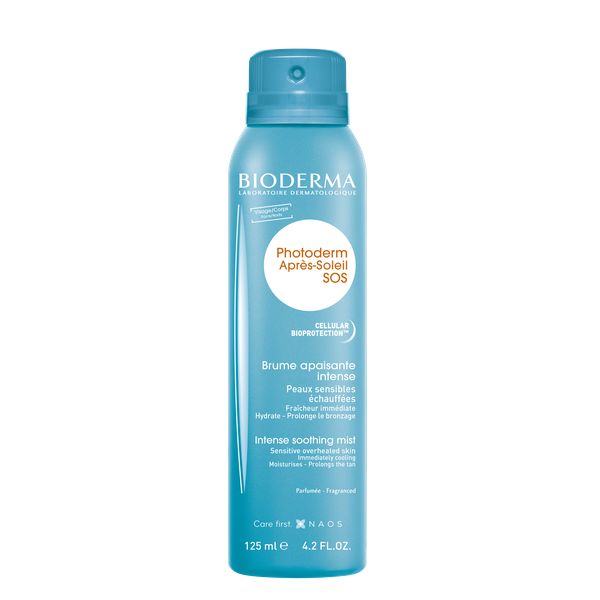
Photoderm Après-Soleil SOS
BIODERMA
PHOTODERM APRES-SOLEIL SOS
Soin solaire Visage, Corps
Le soin apaisant rafraîchissant qui hydrate intensément.
BIODERMA
BIODERMA
PHOTODERM APRES-SOLEIL SOS
Soin solaire Visage, Corps
Chacun de nos ingrédients ont été sélectionnés pour leur efficacité. Retrouvez tous les ingrédients de votre produit regroupés dans des familles en fonction de leur rôle.
Les ingrédients de nos formules ont été sélectionnés selon des critères dermatologiques très stricts et recommandés par des experts toxicologues indépendants. Classés dans trois grandes catégories d’actifs, vous découvrirez la nature, le rôle et l'origine de chacun en cliquant sur leur nom.
Ici sont regroupés les ingrédients qui contribuent à l'efficacité attendue du produit : ceux qui optimisent ou préservent les mécanismes biologiques de la peau (comme l'hydratation, la régénération, l’action relipidante), et ceux qui possèdent une action physico-chimique bien spécifique (exfoliant, matifiant, filtres solaires...).
Les ingrédients listés ici sont ceux contenus dans la dernière formule de ce produit. Un décalage de temps pouvant exister entre sa production et sa diffusion sur le marché, nous vous invitons à consulter la liste des ingrédients figurant sur l’emballage
Rhamnose
Qu’est-ce que c’est ?
Sugar.
À quoi ça sert ?
Soothing: reduces sensations of skin discomfort.
Comment l’obtient-ton ?
Wood extraction or synthesis.
Tocopherol
Qu’est-ce que c’est ?
Vitamin E or tocopherol.
À quoi ça sert ?
Antioxidant: prevents the oxidation of the ingredients contained in the product.
Comment l’obtient-ton ?
Component naturally found in the skin, obtained by synthesis.
To select an ingredient, NAOS can call on synthesis in order to:
- reconstitute a natural molecule without having to extract it from a plant and thus better respect biodiversity,
- obtain a pure, perfectly defined ingredient.
Fructooligosaccharides
Qu’est-ce que c’est ?
Sugar macromolecule.
À quoi ça sert ?
Soothing: reduces sensations of skin discomfort.
Comment l’obtient-ton ?
Biotechnology.
Biotechnology uses biological processes, including natural fermentation, to obtain ingredients.
Caprylic/capric triglyceride
Qu’est-ce que c’est ?
Glycerin and fatty acid derivative (triglycerides).
À quoi ça sert ?
Stabilising: contributes to the product’s homogeneity or stability.
Comment l’obtient-ton ?
A combination of glycerine and fatty acids extracted from vegetal oils.
Laminaria ochroleuca extract
Qu’est-ce que c’est ?
Golden algae extract.
À quoi ça sert ?
Soothing: reduces sensations of skin discomfort.
Comment l’obtient-ton ?
Laminaria algae extraction.
Fragrance (parfum)
Qu’est-ce que c’est ?
Fragrance composition.
À quoi ça sert ?
Scent & Fragrance: provides the product with olfactory sensory appeal.
Comment l’obtient-ton ?
Synthesis
To select an ingredient, NAOS can call on synthesis in order to:
- reconstitute a natural molecule without having to extract it from a plant and thus better respect biodiversity,
- obtain a pure, perfectly defined ingredient.

Pour quel type de peau ce produit est-il fait ? Comment appliquer Photoderm Après-Soleil SOS ? Quand l'utiliser ? Quels sont les formats disponibles ?
Notre démarche de transparence
Bienvenue dans nos Laboratoires à Aix-en-Provence.
Découvrez notre approche scientifique unique, l’écobiologie.